New Line Style Options in PowerPoint 2007

Miter joints are new in PPT 2007. (c) Thinkstock

Miter joints are new in PPT 2007. (c) Thinkstock

If you regularly use shapes and lines in your PowerPoint presentations, you should be familiar with the standard line style options such as width, dash type, and compound style. All of these options were in PowerPoint 2003 and have carried over to the latest version of PowerPoint. In PowerPoint 2007, they have added a couple of new options that you should be aware of  — join type and cap type.

Join Type

I was recently trying to create an explosion shape, and the points of the explosion just didn’t look crisp. As I started exploring in the options, I found that the join type was the culprit.

In PowerPoint 2007, your default setting for join type is round. There are two other options for join type — bevel and miter. In the image below, you can see the differences between each join type on the lightning bolt shape.

For explosions and lightning bolts, the miter join is the way to go.

For explosions and lightning bolts (any shapes with sharp angles), the miter join is the way to go.

The miter join works well with any shapes with sharp or right angles such as squares, rectangles, etc. For example, I used the miter join for my explosion shape, and it looked much better than the default round join. The bevel join looks like someone clipped off the corner of the angle. The differences between the join types aren’t as noticeable if you’re using a thin line width (< 1 pt), but can be very noticeable if you’re using a very thick line width (> 3 pt).

Cap Type

Once I discovered the effect of the join type setting, I became curious about the cap type setting. The cap type setting is only used with open shapes (e.g., lines), not closed shapes (e.g., squares). The cap type controls the endings of lines as well as the format of dashed lines. The default setting is flat, and you have two other settings — square and round. In the image below, you can compare the effect of each setting:

The flat and square settings are so similar, we probably didn't need both options.

The flat and square settings are so similar, we probably didn't need both options.

There’s not really a huge difference between the flat and square options. The square option lengthens the line a little beyond the end points, but that’s about it as far as I can tell. The round option creates rounded end points for a line, and if it is a dashed line then each of the dashes will be rounded as well. I wish the arrow point on a line could have been rounded as well, but it isn’t changed by the cap type setting.

How to access line style settings

Most of these options should be familiar.

Most of these options should be familiar.

If you’d like to adjust the line style settings on one of your lines or shapes, you need to right-click on the object. On the pop-up menu, select Format Shape which is at the bottom of the menu. On the subsequent menu, select the Line Style tab from the left-hand side. You’ll then see the different line style options including the new join and cap type options. Good luck!


PowerPoint SmartArt is Dumb

Theres no Bob Ross feature in PowerPoint to guide you through the process of visual communication.

SmartArt is not PowerPoint + Bob Ross.

PowerPoint is often criticized for encouraging presenters to rely too heavily on bullet points and not helping people to communicate more visually. Microsoft added a feature known as SmartArt to help convert text into various stylized graphics. When you’re designing your PowerPoint presentation, you can quickly rotate through various shapes, colors, layouts, and styles in order to find the right graphic for your presentation.

For novice or casual PowerPoint users, SmartArt can be a handy tool for quickly making your presentation more visual and professional looking. If you decide to use SmartArt in your PowerPoint slides, you need to be careful because SmartArt is dumb.

Warning: SmartArt is dumb

Im not calling SmartArt stupid...just dumb.

I'm not calling SmartArt stupid...just dumb. (c) Shutterstock

Hear me out before you say, “Hey, PowerPoint Ninja, you’re dumb! SmartArt is the greatest.” By “dumb” I don’t mean “stupid”. When I refer to SmartArt as dumb, I mean what the Merriam-Webster dictionary refers to as “not having the capacity to process data.” In other words, SmartArt is not going to intelligently guide you to a diagram style that is appropriate for your content. SmartArt provides you with lots of visual options, but it is up to the presenter to choose an appropriate graphic based on his or her content. This is where presenters and SmartArt can go wrong.

Recently, I was asked to fix some slides that someone else had built. The main slide of the presentation emphasized the three core teams (consulting, training, and client support) within our client services department. The designer had used a diagram with three flowing circular arrows that has been re-purposed several times in various presentations at my company. The diagram wasn’t a SmartArt graphic, but like SmartArt it was used as a more visually attractive alternative to a boring list of bullet points.

The circular flow diagram wasnt appropriate in this case. The diagram needed to align better with the content -- aesthetics aside.

The circular flow diagram wasn't an appropriate diagram in this case. The diagram needed to align better with the content -- aesthetics aside.

Replacing bullet points with the wrong graphic is worse than just having bullet points. It’s a downgrade, not an upgrade. The circular motion of the graphic implied that our customers flowed through consulting to training to client support — and then the whole process would be repeated over and over. If our clients never had to work with our client support team, I wouldn’t see that as a problem. And yet the diagram’s circular flow implied our customers would rotate through the different teams when this wasn’t intended or wanted. The diagram didn’t accurately portray what needed to be communicated — that these three teams are the core foundation of our client services organization. As a result, I changed the circular-arrow diagram to different diagram with three pillars — each pillar representing one of the three teams.

Choose your diagrams wisely

With diagrams you need to remember that the diagram style contributes to the overall message just as much as the actual labels do. You need to choose an appropriate graphic for what you’re trying to communicate. Each type of diagram — chart, map, timeline, venn, etc. — has different strengths, weaknesses, and preconceptions. PowerPoint users may not realize that Microsoft provides helpful descriptions of each SmartArt graphic and how they should be used in the SmartArt pop-up window.

Read the descriptions to make sure youre choosing appropriate SmartArt graphics.

Read the descriptions to make sure you're choosing appropriate SmartArt graphics.

If you’re looking for further guidance, Dan Roam’s book “Back of the Napkin” focuses on developing better visual thinking and provides a good framework for choosing appropriate visuals.

SmartArt just got smarter!

If SmartArt was so smart, why couldnt I ungroup it? (c) Shutterstock

If SmartArt was so smart, why couldn't I ungroup it? (c) Shutterstock

You may be wondering if PowerPoint ninjas are too cool to use SmartArt. Actually, I’ve frequently wanted to use this feature, but a fatal flaw of SmartArt has been the inability to ungroup and customize SmartArt objects directly. It was unfortunate that I couldn’t use a SmartArt graphic to get 50-75% of what I needed and then customize the remaining parts of the graphic to my liking. Unless my concept matched up nicely with one of the preset SmartArt graphics, I really had no use for SmartArt (99.9% of the time).

With the release of Office 2007 Service Pack 2, you can now ungroup SmartArt graphics. Rather than being forced to build your own ideas entirely from scratch, you can now ungroup and edit SmartArt objects when appropriate to save time. This small change turns SmartArt into another useful tool in your PowerPoint tool box. I’m glad I installed SP2 as it has fixed a number of annoying issues in PowerPoint 2007 and added this new option for ungrouping SmartArt (Note: Consult with your IT team before installing any service pack just to be safe). Kudos to Microsoft for making this change!

Office 2007 SP2 enables PowerPoint users to ungroup SmartArt.

Office 2007 SP2 enables PowerPoint users to ungroup SmartArt. Just right-click on the SmartArt graphic and select Group > Ungroup.


PowerPoint 2007: Recent Documents and Push Pins

Push pins in PowerPoint 2007 can be time savers

Push pins in PowerPoint 2007 can be time savers (c) iStockPhoto/Talaj

If you work with multiple PowerPoint presentations each week, it can be difficult to quickly find key presentations when you need them at a moment’s notice. I’m frequently reviewing other people’s PowerPoint slides and going back and forth between several of my own presentations. There are a couple of new features in PowerPoint 2007 that can benefit heavy PowerPoint users and save you time. More…


Three New Gradient Effect Options in PowerPoint 2007

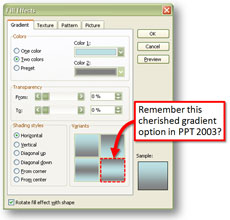
If you’re familiar with using gradient fill effects in PowerPoint, you will have noticed a change in how PowerPoint 2007 handles gradient effects (see below). In a previous article, I showed how you could reproduce the familiar gradient fill effects from PowerPoint 2003 in PowerPoint 2007.

On the left side are the gradient fill options in PowerPoint 2003. On the right side are the gradient fill options in PowerPoint 2007.

A side-by-side comparison of the gradient fill effect options shows how the application features have changed from PowerPoint 2003 to PowerPoint 2007.

Now I’ll focus on three new gradient features in PowerPoint 2007 that may open up some new effect options for you. More…


Mastering Gradient Fills in PowerPoint 2007

When you upgraded to PowerPoint 2007 from PowerPoint 2003, you might have noticed a big change in the way gradient fill effects work. When I first started using the new gradient fill effect options in PowerPoint 2007, I was a little frustrated with it. I thought that some gradient functionality had actually been removed. However, once you get oriented with the new gradient fill approach, you realize you can do what you did before with gradients and much more. More…


Page 1 of 3123»